


Hey there! As a supplier of aramid short cut fiber, I've been diving deep into the world of these amazing materials. One of the most fascinating aspects I've come across is how crystallization impacts the performance of aramid short cut fiber. In this blog, I'll share my insights on this topic, so let's get started!
What is Aramid Short Cut Fiber?
Before we jump into the details of crystallization, let's quickly go over what aramid short cut fiber is. Aramid fibers are a class of strong and heat-resistant synthetic fibers. They're made from polyamides where at least 85% of the amide bonds are attached directly to two aromatic rings. These fibers are known for their high strength-to-weight ratio, excellent thermal stability, and good chemical resistance.
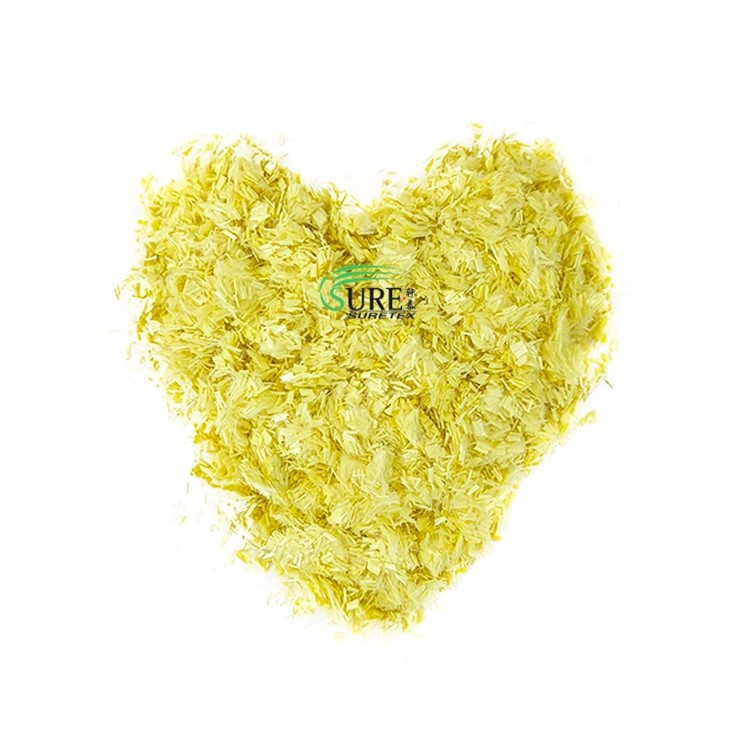
Aramid short cut fiber is simply aramid fiber that has been cut into short lengths, typically ranging from a few millimeters to a few centimeters. These short fibers are used in a wide variety of applications, including friction materials, composites, and reinforcement in rubber products.
The Role of Crystallization in Aramid Short Cut Fiber
Crystallization is a process where molecules arrange themselves into a highly ordered, repeating pattern. In the case of aramid short cut fiber, crystallization plays a crucial role in determining the fiber's performance. Here's how:
1. Strength and Stiffness
The degree of crystallization in aramid short cut fiber has a direct impact on its strength and stiffness. When the fiber has a high degree of crystallization, the molecules are tightly packed together in an ordered structure. This allows the fiber to withstand higher loads without deforming, resulting in greater strength and stiffness.
For example, our High Strength Aramid Short Cut Fiber is engineered to have a high degree of crystallization. This makes it ideal for applications where high strength is required, such as in aerospace composites and high-performance sports equipment.
2. Thermal Stability
Crystallization also affects the thermal stability of aramid short cut fiber. A highly crystalline fiber has a more stable molecular structure, which can better withstand high temperatures without breaking down. This is because the ordered arrangement of molecules in the crystalline regions provides stronger intermolecular forces, making it more difficult for the fibers to melt or degrade when exposed to heat.
Our Wear Resistant Aramid Short Cut Fiber benefits from a high degree of crystallization, which gives it excellent thermal stability. This makes it suitable for use in high-temperature environments, such as in brake pads and clutches.
3. Chemical Resistance
The crystallization of aramid short cut fiber can also influence its chemical resistance. A well-crystallized fiber has a more compact structure, which can prevent chemicals from penetrating the fiber and causing damage. This is particularly important in applications where the fiber may come into contact with harsh chemicals, such as in chemical processing plants or in the oil and gas industry.
4. Dimensional Stability
Dimensional stability is another important property that is affected by crystallization. A fiber with a high degree of crystallization is less likely to change its shape or size when exposed to changes in temperature, humidity, or mechanical stress. This is because the ordered structure of the crystalline regions helps to maintain the fiber's shape and dimensions.
Our High Dimensional Stability Ramid Short Cut Fiber is designed to have a high degree of crystallization, which provides excellent dimensional stability. This makes it ideal for applications where precise dimensions are critical, such as in electronic components and precision machinery.
Factors Affecting Crystallization in Aramid Short Cut Fiber
Several factors can influence the crystallization process in aramid short cut fiber. Here are some of the most important ones:
1. Polymer Structure
The chemical structure of the aramid polymer itself plays a significant role in determining the degree of crystallization. Different types of aramid polymers have different molecular structures, which can affect how easily the molecules can arrange themselves into a crystalline pattern. For example, polymers with more linear and regular structures tend to have a higher degree of crystallization.
2. Processing Conditions
The processing conditions during the production of aramid short cut fiber can also have a major impact on crystallization. Factors such as temperature, pressure, and the rate of cooling can all affect the formation of crystalline regions in the fiber. For example, slow cooling rates generally allow more time for the molecules to arrange themselves into an ordered structure, resulting in a higher degree of crystallization.
3. Additives
The addition of certain additives can also influence the crystallization of aramid short cut fiber. Some additives can act as nucleating agents, which promote the formation of crystalline regions in the fiber. Other additives may affect the mobility of the polymer molecules, which can either enhance or inhibit crystallization.

Controlling Crystallization for Optimal Performance
As a supplier of aramid short cut fiber, we understand the importance of controlling crystallization to achieve optimal performance. We use advanced manufacturing processes and carefully select the polymer materials and additives to ensure that our fibers have the desired degree of crystallization.
By controlling the crystallization process, we can tailor the properties of our aramid short cut fiber to meet the specific requirements of different applications. Whether you need high strength, excellent thermal stability, or good chemical resistance, we can provide you with the right fiber for your needs.
Conclusion
In conclusion, crystallization has a profound impact on the performance of aramid short cut fiber. It affects the fiber's strength, stiffness, thermal stability, chemical resistance, and dimensional stability. By understanding the factors that influence crystallization and controlling the process during production, we can produce aramid short cut fiber with the optimal properties for a wide range of applications.
If you're looking for high-quality aramid short cut fiber for your project, we'd love to hear from you. We have a wide range of products available, including Wear Resistant Aramid Short Cut Fiber, High Strength Aramid Short Cut Fiber, and High Dimensional Stability Ramid Short Cut Fiber. Contact us today to discuss your requirements and start a procurement negotiation.
References
- "Aramid Fibers: Science and Technology" by J. W. S. Hearle, B. L. Johnson, and P. H. Blackwell
- "Handbook of Fiber Chemistry" edited by Menachem Lewin and Eli M. Pearce
- "Polymer Crystallization" by I. M. Ward and J. Sweeney


